
Fire and Smoke Alarms Regulations in Scotland
CSS supply and install the highest performance smoke, heat, fire and carbon monoxide (CO) alarms and accessories to support all installations to specifiers’ needs.
Are you compliant with the new regulations?
Changes to Scottish fire safety regulations
When do I need to be ready?
All homes in Scotland must meet the new regulations. The deadline was 1 February 2022. If a property is not up to standard, your local authority could use its statutory powers to make you carry out any work required.
Where do I need alarms?
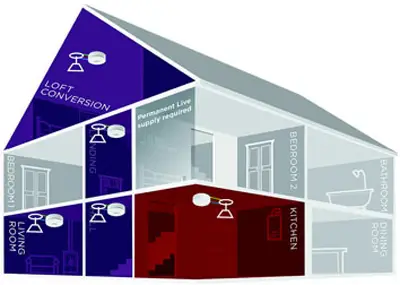
- Living room
- Hallway
- Landing
- Kitchen
- Loft conversion
What properties are affected?
What type of alarms do I need?
- Mains-powered with battery back-up, interlinked with wiring or wirelessly.
- Tamper-proof, sealed, long-life lithium battery, interlinked or wireless.
When choosing a CO detector, always check that it complies with BS EN 50291, and that it’s powered by a long-life battery. Also remember to check that it has a warning device that will alert you when it’s about to expire.
A mains-powered detector can also be used, providing it complies with BS EN 50291 (Type A).
Whatever you choose, your CO detector should be regularly maintained and tested.
What about my existing system?
If you’re adding new alarms to an existing fire detection system, you’ll need to ensure that all devices are interlinked, so every alarm sounds when one device is activated.
Where should I install smoke and heat alarms?
- Regularly used rooms: A smoke alarm MUST be fitted in the most frequently used room, e.g. the living room or lounge.
- Access walkways: A smoke alarm MUST also be installed in every circulation space on each storey of the home, e.g. the hallway or landing.
- Cooking areas: You MUST install a heat alarm in every kitchen.
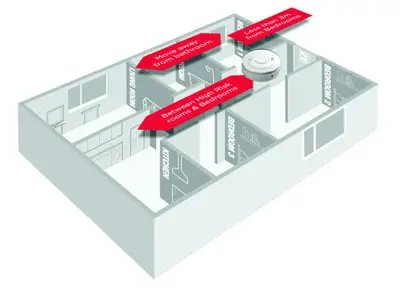
- Sleeping areas: We recommend that there should be an alarm within 3m of every bedroom door, so it can be heard clearly by whoever’s inside.
- Rooms to avoid: Alarms should NOT be fitted in bathrooms or outside bathroom doors, as they can be affected by steam and moisture.
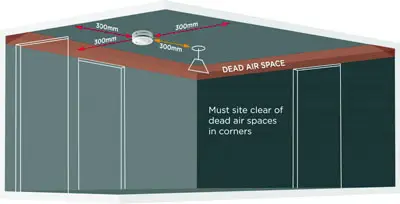
- Safe alarm positioning: Ensure alarms are positioned 300mm away from walls, light fittings or other obstructions.
- Safe stairways: On stairways, we put the alarm at the top and bottom of the stairs – not on the sloped ceiling directly above it.
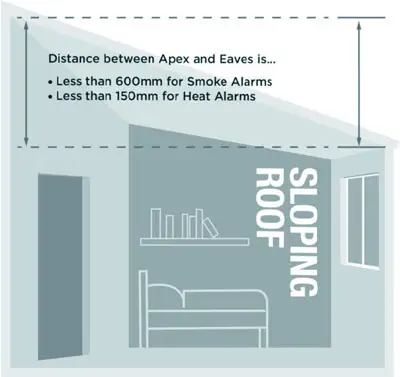
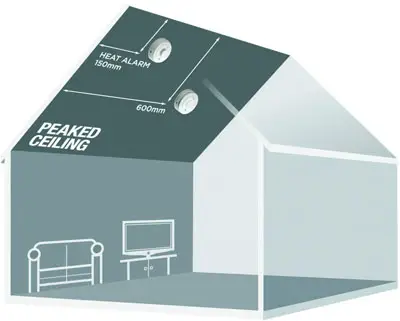
- Sloped ceilings: On peaked and sloped ceilings, smoke alarms will be fitted 600mm vertically down from the apex and heat alarms positioned 150mm vertically down from the apex.
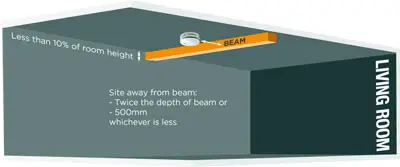
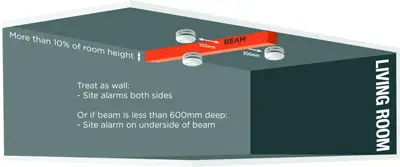
- Ceiling beams: If your room has a beam, it can affect where the alarm must be fitted.
Carbon Monoxide (CO) Alarms
What is carbon monoxide?
Carbon monoxide (CO) is a toxic gas that has no colour, taste or smell. Exposure to low levels can cause headaches and nausea. High levels can cause death within minutes.
CO can be produced by any fuel-burning appliance such as a boiler, gas fire, gas cooker or wood-burning stove. Because it’s impossible for humans to tell if CO is present, the only way to protect against it is to install a suitable CO detector. The new regulations apply to such alarms.
Where do I need a CO alarm?
- Fit alarms on the ceiling, 1m-3m from potential CO sources, and at least 300mm from any obstructions.
- In a confined space, e.g. a boiler room, fit the alarm on the ceiling just outside.
- Alarms should always be fitted at breathing height.
- If installed in a bedroom, this could be the height of the bedhead.


The Repairing Standard
What is the Tolerable Standard?
Connelly Security Systems is working in partnership with Aico to provide information on the new regulations. We are both happy to discuss any questions you may have about preparing your property and offer a full survey, quote, installation and maintenance service for all your needs.
For more information about Fire and Smoke Alarms Regulations in Scotland call us on 0800 783 6486, email us or use our enquiry form.
Why Choose CSS Limited
We are a family business operating since 1986. Since then we have built up a highly skilled and
accredited team of dedicated and loyal staff committed to putting customers first.

Dedicated to protecting
your home or business
since 1986.

Professional & Accredited
Team. No one’s more
qualified to keep you safe.

State-of-the-art
alarm receiving centre for
24/7 security monitoring

BOOK
MAINTENANCE
Request a maintenance appointment

Free
Call Back
Let us know the best
time for us to call you

SUPPORT
TICKET
Contact us for rapid
engineering support

SECURITY
QUOTE
Free no obligation
consultation