Types of Fire Alarm Systems
Fire Alarm Systems Installed to BS Standards
For maximum protection of your business and employees, CSS recommend that a BS5839 PT1:2017 standard fire alarm system is installed to provide the best chance of detecting any fire threats.
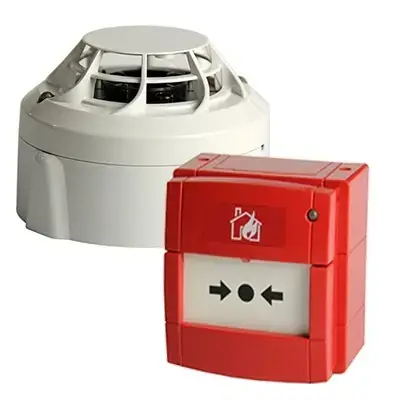
CSS supply, install and maintain BS5839 PT1:2017 fire alarm systems which, like all fire alarm systems, operate in the conventional way: to alert those within and surrounding the building of the threat by sounding a loud warning noise if smoke or heat is detected or if somebody operates the ‘break glass unit.’ Certain fire alarm systems will also notify the local fire brigade if remote signalling equipment is installed.
There are four main types of fire alarm systems that CSS recommend and install:
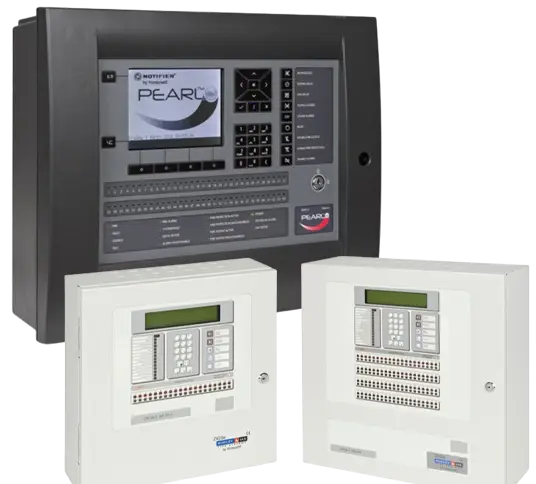
Conventional Non-Addressable Fire Alarm Systems
With a conventional fire alarm system, there is one main fire alarm control panel. This is connected by wires to various zones. Zones generally refer to each level of a building, meaning if a fire begins the location can be identified quickly, allowing the fire brigade to direct their efforts towards the starting point of the fire. The main control panel is also connected to at least two sounder circuits which send out a loud warning sound/bell if a fire is detected.
Analogue Addressable Fire Alarm Systems
Analogue addressable fire alarm systems are more complex and tend to be used for larger buildings. The control panel is wired up to detectors throughout the building. With a standard analogue system, these detectors do not determine whether there is a fire or fault as this is determined by the main control unit meaning accuracy may not be as high.
However, in an intelligent analogue system (which CSS would recommend) each detector has its own computer and can determine exactly whether there is a fire or fault which is communicated to the main control panel. Each detector has its own unique address meaning the location of the fire can be identified quickly by the control panel. Different loop versions are available with the analogue fire alarm system, therefore, addressing the needs of different sized locations.
Wireless Fire Alarm Systems
Wireless fire alarm systems make use of radio communications to link all devices to the main controllers. Radio signals are sent to the main controller in the event of heat or smoke detection. This is essentially an analogue addressable fire alarm system without cables, therefore, the same benefits apply.
Aspirating Fire Alarm System
An aspirating system enables smoke to be detected in the very early stages of a fire, which could help stop the potential spread of fire. This is due to its air sampling system which samples air through pipes/tubes and draws it towards the aspirating system which allows it to detect smoke.
The main benefit of an aspirating fire alarm is its sensitivity which as stated allows smoke to be detected at the very early stages therefore potentially preventing widespread destruction.
Choosing the right fire alarm system for your business
If you are confused about which system to ask for, don’t be. CSS have a team of fully trained fire alarm experts that can survey your premises and identify and advise on the most suitable fire alarm system.
We will also explain why we would recommend the system we think is best suited to you.
Why Choose CSS Limited
We are a family business operating since 1986. Since then we have built up a highly skilled and
accredited team of dedicated and loyal staff committed to putting customers first.

Dedicated to protecting
your home or business
since 1986.

Professional & Accredited
Team. No one’s more
qualified to keep you safe.

State-of-the-art
alarm receiving centre for
24/7 security monitoring

BOOK
MAINTENANCE
Request a maintenance appointment

Free
Call Back
Let us know the best
time for us to call you

SUPPORT
TICKET
Contact us for rapid
engineering support

SECURITY
QUOTE
Free no obligation
consultation